Morris Chang interview takeaways
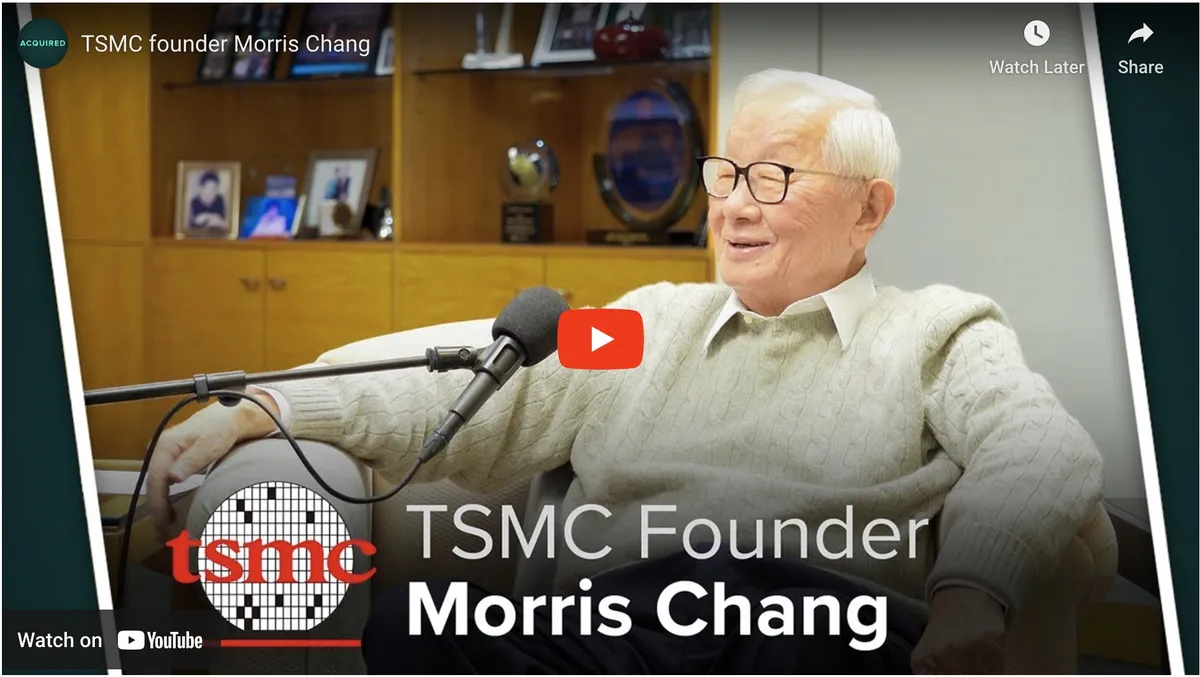
Source: TSMC Founder Morris Chang | Acquired Podcast (January 2025)
1. Take small customers seriously; you never know who they’ll turn into
- When Jensen reached out to Morris in 1997, Nvidia had just laid off half its employees and was down to its last month of payroll. It was going out of business if Jensen didn’t secure a foundry partnership.
- TSMC was already at >$1B run rate, but MC took the time to visit Jensen personally. “I told our salespeople we should never be negligent in talking to future customers, even if they’re small.”
2. Boldness counts
- Jensen: “If you work with us, we will grow into a major customer for TSMC.”
- This is the business equivalent of a 6th round draft pick telling the franchise owner: “I'm the best decision this organisation has ever made.”
3. On repairing customer trust
- 2009: TSMC had production issues on 40nm node that caused Nvidia a great deal of pain.
- Rather than playing the blame game, MC did the math and offered ~$100m to settle the dispute. Jensen accepted within 48 hrs and they moved forward with their partnership.
4. Pushing all your chips in might be unpopular, but necessary
- Steady-state TSMC reinvests 8% of revenue back into R&D. In the early 2010s, MC realised 28nm would be their chance to surpass competitors in advanced process nodes.
- So he increased R&D spend and ramped capital expenditure 3x to $6B that year, against strong pushback from his board.
- On the decision to go all-in, MC quotes Shakespeare’s Julius Caesar: “There is a tide in the affairs of men, which taken at the flood, leads on to fortune… On such a full sea are we now afloat, and we must take the current when it serves, or lose our ventures.”
5. The Apple deal
- 2010: Terry Gou (Foxconn) brought Jeff Williams (Apple) to dinner at MC’s home. He wants TSMC to produce chips for the next iPhone.
- TSMC was already approaching ~50% gross margins, but took 40% to win the deal. They financed the heavy CapEx needed to fill the order. If iPhones didn’t sell, they’d be in trouble.
- Initially split volume with Samsung, but over time TSMC became Apple’s sole foundry partner.
6. Rather than trying to predict market trends, MC reasons first from physics
- This was the dawn of the mobile and data centre mega-waves, but MC didn’t have strong opinions on how big a deal these segments would end up being.
- He knew only that demand for sub-14nm will require: 1) EUV, 2) FinFET, and 3) compound semi materials (e.g. SiGe doping). If TSMC perfected these 3 technologies sooner than Intel (whose tech leadership was already waning), they’d become the best foundry (h/t Yiwen Rong).
- In fact, in ’09, TSMC thought the TAM expansion would come from solar panels and LED (neither panned out). ~You can be right even when you’re wrong.~
7. If you don’t build it, they can’t come
- Prevailing SV teaching is to avoid building a solution in search of a problem.
- The “fabless” market was ~non-existent when TSMC was founded. The best they could do was serve as excess fab capacity for integrated device manufacturers.
- They had to grind it out, build out the infra, & become operationally excellent before the fabless customers emerged.
- Markets are reconfigured & entrenched defaults displaced when a new crop of customers enters with different needs and expectations. There’s a level of reflexivity at play too, since many chip startups of that era couldn’t have been started without TSMC.
8. Misc. management philosophy
- De-risk customers’ optimistic forecasts by taking deposits (confiscated if orders don’t materialise).
- Doesn’t believe in layoffs based on performance reviews since they’re subjective.
- Prefers a functional to a divisional org structure (e.g. Boeing).
- Learning curve pricing. Are strategy consultants useful? Sure, if they’re Bill Bain.
- Plant seeds early on that pay off later, e.g. multi-year courting of Qualcomm, Goldman’s financing support on the Apple deal.
- Control your own destiny. Turned down IBM co-development deal to keep engineering prowess in-house. What is expedient isn’t always strategic.
9. Make no small plans
- Of the top 10 most valuable companies in the world today, TSMC is one of only two not founded on the West Coast of the US. Surely he’s surprised by their eventual success?
- Chang says no. Why couldn’t a startup founded in Taiwan become one of the largest in the world?